Brock DeBoer Describes Umberto Boccioni
Artist Bio
Brock DeBoer's (b.1985, South Dakota, USA) artistic process as a ceramic sculptor utilizes porcelain, historical motifs and surface treatments to recontextualize everyday objects, items from his past, and objects of popular culture. Many are highly nostalgic to his generation and beyond, touching on facets of everyday life. DeBoer’s highly crafted casts in porcelain become archival, altering their permanence while questioning the value of such everyday objects. DeBoer draws influence from his Midwestern upbringing combined with the ever-changing and vastly diverse landscape of Los Angeles and the rural landscape of Joshua Tree. DeBoer currently lives and works in Los Angeles and Joshua Tree, CA. Recent exhibitions include - “Far from Home” with Guy Hepner Editions, New York, NY, “Knee High by the 5th of July” with Haw Contemporary, Kansas City, MO, “what we’ve got here is a failure to communicate” with BBQLA at the Torrance Art Museum, Torrance, CA and “NO BULL” with Square One Gallery, St Louis, MO. His solo exhibition, 'So Far,' took place at Compound YV Mar. 29 – Jun. 1, 2025.
Podcast Transcript
Lara Wilson: Welcome to Art Personals, a podcast made by Compound Yucca Valley, an art and event space in California's high desert.
We ask some of our favorite artists to describe another artist's work as best they can, using only their words and sounds. The one parameter is that the object they choose must be one they have seen in person at some point in their lives, whether that's an ancient artwork in the Metropolitan Museum of Art, or a friend's painting in a garage.
In this episode, we've invited Brock deBoer to share his experience with Umberto Boccioni's Unique Forms of Continuity in Space. Brock deBoer's artistic process as a ceramic sculptor uses highly crafted cast porcelain, historic motifs and surface treatments to recontextualize objects of popular culture.
Many are highly nostalgic to his generation and touch on facets of everyday life. DeBoer draws influence from his South Dakota upbringing, combined with the ever-changing and vastly diverse landscape of Los Angeles and the Joshua Tree area.
His solo exhibition, So Far, was presented at Compound YV in the spring of 2025.
Brock DeBoer: Hello everybody. My name's Brock DeBoer. I'm coming from Joshua Tree, California, and today I am going to talk about Umberto Boccioni's Unique Forms of Continuity in Space. Yeah, it was kind of interesting and funny thinking back when I was gonna do this podcast of, you know, what piece do I want to talk about? Where did I first see it? Because I actually thought I first saw this in London at the Tate, which they also have a copy of it. Um, so I, I got kind of mixed up and then realized, actually I'd seen this before that, in New York.
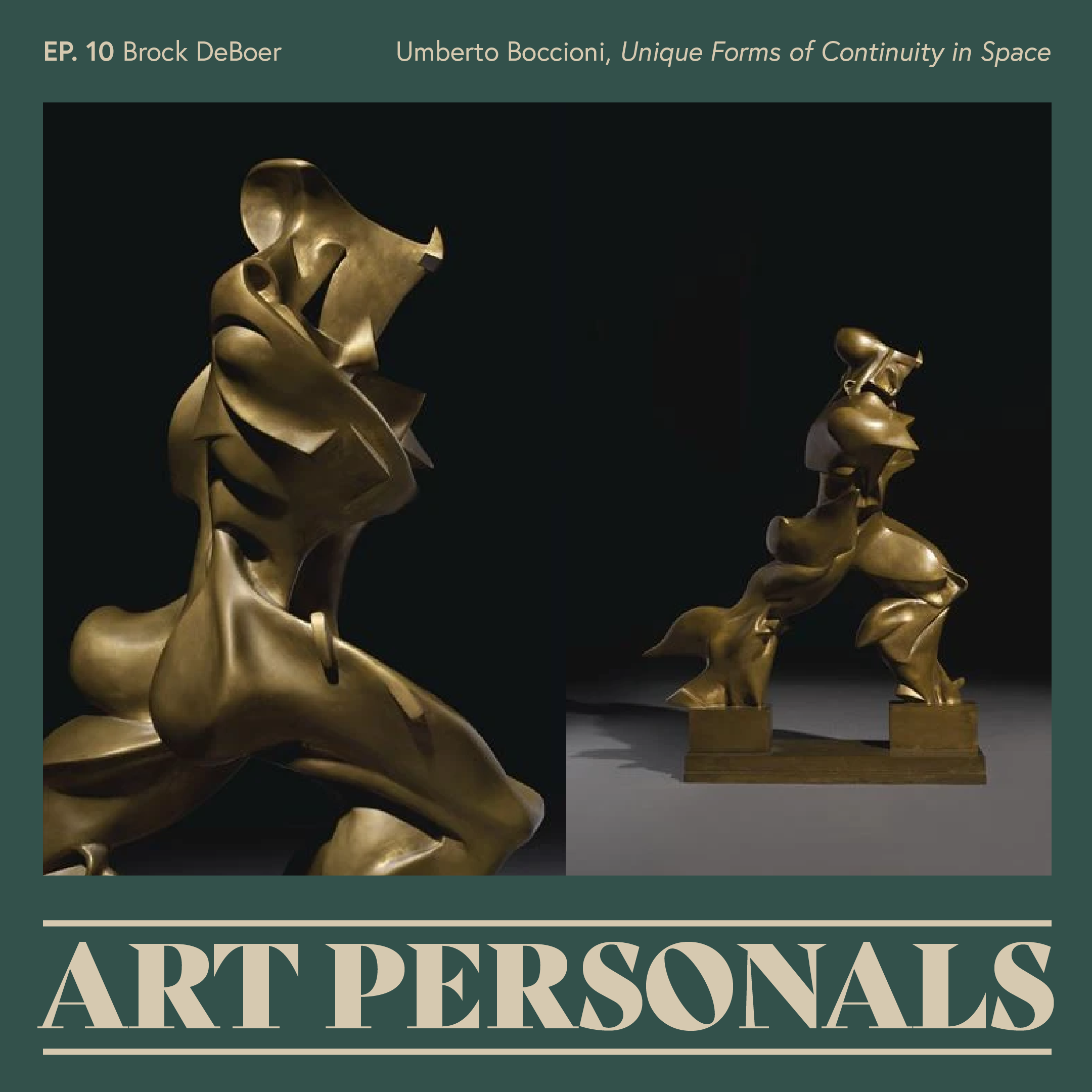
I don't know a ton of in-depth history about the artist's background. I do know he is Italian. Um, you know, working around the turn of the century, was born in the late 1800s, began as a painter, and then started to develop his futurist style through paintings, which then led to sculpture and to my favorite sculpture of his, which is called Unique Forms of Continuity in Space. It was originally sculpted in plaster and since several bronzes have been made, um, and the first time I saw this sculpture in person, I had learned about this sculpture in a sculpture class in college, and, you know, saw it and was just immediately like, wow.
In my mind, I was like, "This is a sculpture. This is what it's all about." And the first time I saw it was at the Metropolitan in New York, and I remember kind of feeling surreal, like, wow, I'm actually seeing this thing in real life in front of me. I even was looking back at some of the photos I have of me standing next to it, just standing next to that monument that you're finally seeing.
And I remember, you know, just trying to take it all in and think about the scale of it. It was kind of different than I expected. Um, the impact of it was a lot greater than I expected. For some reason seeing it in photos, I always imagined it being this, you know, larger than life thing, but it was about human scale, slightly smaller.
Seeing it at the Met, of course, is an experience because you're surrounded by tons of people. Um, so I do remember, uh, trying to get that photo and to have that moment and being really annoyed that it was just constantly competing with other people that wanted to get up and look at it and do the same thing as me.
I just wanted to have my few minutes of pure enjoyment. So I do remember spending a lot of time kind of wandering and waiting for those moments and being in that gallery of a bunch of other tourists wandering through. You know, other people passing right by and other people enjoying it like I was, so.
Interlude
I will say, and even looking back at the photos, the lighting was awful. Like, so horrible compared to what I was about to experience. Which is, later in the same day, I went to the Museum of Modern Art and actually saw another version of this, um, sculpture. And I've come to find out that the one that I saw at the Museum of Modern Art was actually one of the first two copies of the original sculpture — o ne of the first two bronze copies that were made. And I believe that was in 1931 because this piece was made in 1913. Yeah, so oddly enough, later in that day, I go to the Museum of Modern Art and I see the same sculpture, but it's displayed differently.
When, I'll back up a little. Previously at the Met, that room was painted in this dark forest green. The walls. And the carpet was this really dark gray, and the lighting was very, like lots of real hot spotlights, pretty bad if I'm being honest, a lot of hard shadows and just, this piece especially is so angular.
They really didn't do it a lot of justice with the way they lit it. Now that I think back to it of just how it was like just broad side lit on one side and the backside's just completely dark and there's all of these shadows, which for this piece really changes your perspective of it because the, the work just folds over itself.
Not until later I'm thinking back and like, wow, yeah, that was really bad because then I go to the Museum of Modern Art and I see this bronze, which is different because it's actually polished versus the first one I saw was much duller, not as polished in that bright, shiny bronze, and it was on a white pedestal, brightly lit. It, it was like a completely different experience.
And to me, it was almost kind of funny to see it twice because it was like I, I got to relive that experience the proper way, I guess, in my mind, where when I saw that second one, I was like, wow, yeah, this is really it. You know, just on that pedestal, just singing, all those angles and points and corners and all the round parts with the highlighted area.
It just really was amazing to see that way. So , I saw it in two different ways. One felt very institutional. Like I was looking back at this like historical object, um, like a fossil almost. And then the other was like, this is a celebrated art object.
Interlude
Some of the things that I really resonate with on this sculpture are the control of the material. And it's something that I kind of feel that I've developed in my practice. You know, more recently from, you know, back when I was learning about this sculpture is, taming and controlling this material such as bronze or plaster, or in my case, porcelain, and giving it these qualities that make it feel soft, but also angular at the same time. Give it motion, give it life. But at the end of the day, it's this hard, rigid material. So this sculpture for me in particular, it's like you can see it moving, in my mind it's like, I can see how all of this is kind of being captured.
I, I see the movement. It's almost as if the sculpture just wants to step right off the pedestal and it is right in stride. Um, and I think it's something that I see in my work when, say I deflate a porcelain basketball, and by deflating that I've, I've given this really rigid material, this super soft quality of something that's normally made of rubber.
Something like that. Cloth, even, like a soccer ball stitched together. It's like giving it that softness that's not inherent of the material, something that I really see in this. And, the other thing is just the craftsmanship. Every detail, corner, piece, is finished, everything's thought of, every surface is gone over.
And for me that's something that is really important in capturing the objects that I do, is there's no room for leaving that mess or that little thing. Occasionally I'll leave a sign of my hand in some small way, but there's a lot of times that, you know, artists, I just feel, get lazy and they chalk it up to like, oh, it's gestural, it's that.
But to me, it's so important to really show that craft. And this, to me, exemplifies so much of that, of just pure skill and craftsmanship and really meticulously going over this. But in the end, the result, it shines through. You see all of that care and all of those hours and all that time and thought going into really capturing how to alter that material into something that it's not.
It's just amazing.
Interlude
When I think about this object, when I imagine it in my mind, I see like on the legs there's sort of these flowing pieces coming off the back and I, I literally see them moving, like a flag, like flapping, kind of like this form is really, truly just frozen in a moment of mid-stride, trucking along.
And almost like a transformer in a way. I imagine it just sort of like unpacking and unfolding itself as it's kind of tumbling through this space and, like all those really futurist angular lines and dividing up and breaking things into sections or different angles or perspectives is just like this continuation. Much like the title, Unique Forms of Continuity in Space, it's just this thing that's kind of like folding over its human-like shape, but it's just kind of just unwrapping itself and re-wrapping at the same time.
I've always thought about this sculpture and just how simple, yet complex. All the life that's captured in it. But yet all of the pure materiality and you can enjoy it from so many perspectives of, you know, I, I'm looking at this as a sculptor, or you then look at an image of it and you can really see, when you look at the futurist paintings or his early futurist paintings, how this evolved from all of those sort of angular lines and kind of breaking up the different planes and putting them into sort of a skewed perspective here and there. Almost like you're seeing it from all these different angles at once.
And reading more into the history of this artist and what's happened to so many, is that he made it to 30-some years old, was at the height of his career as he passed. And then, you know, from there his work is celebrated. But shortly after, many of his works were destroyed and they were all made in plaster, so.
It, it's just interesting when you see what artists were then and how their lives were and practices were and, and what we live in and the art world that we have, and how there's so many similarities in the work and the drive to be an artist and, you know, the desire to express that passion and that story or that feeling.
And this is like turn of the century, early 1900s. How they would form their groups and they were very much outliers in a way of, you know, like respected for their craft, but also doing something that people thought was frivolous and not, you know, worth always the investment of time and dedication to doing all of this.
So, yeah, I mean, incredible artist and sculptor. Somebody that I've always kind of had in the back of my mind of, that piece was one of those that I'll forever have floating around, never will forget, can't wait to actually you know, getting back to seeing it again. Kind of curious how my reaction would be now. I've made so many different things. Evolved my practice so much since the first time I saw this, so it'd be very fun to go back and do it again.
Lara Wilson: Thanks for listening to Art Personals, a podcast produced by Compound Yucca Valley. You have been listening to Brock deBoer discuss his encounter with Umberto Boccioni's Unique Forms of Continuity in Space. You can learn more about Compound YV Foundation, donate to our nonprofit organization and stay tuned for future episodes over on our website and our Instagram @compoundyv. Art Personals is produced by me, Lara Wilson, Michael Townsend, and Caroline Partamian in collaboration with our artists. Original music by Ethan Primason.
We curate shows for our virtual and physical spaces. If you are an artist interested in working with us, please send an email to hello@compoundyv.com.